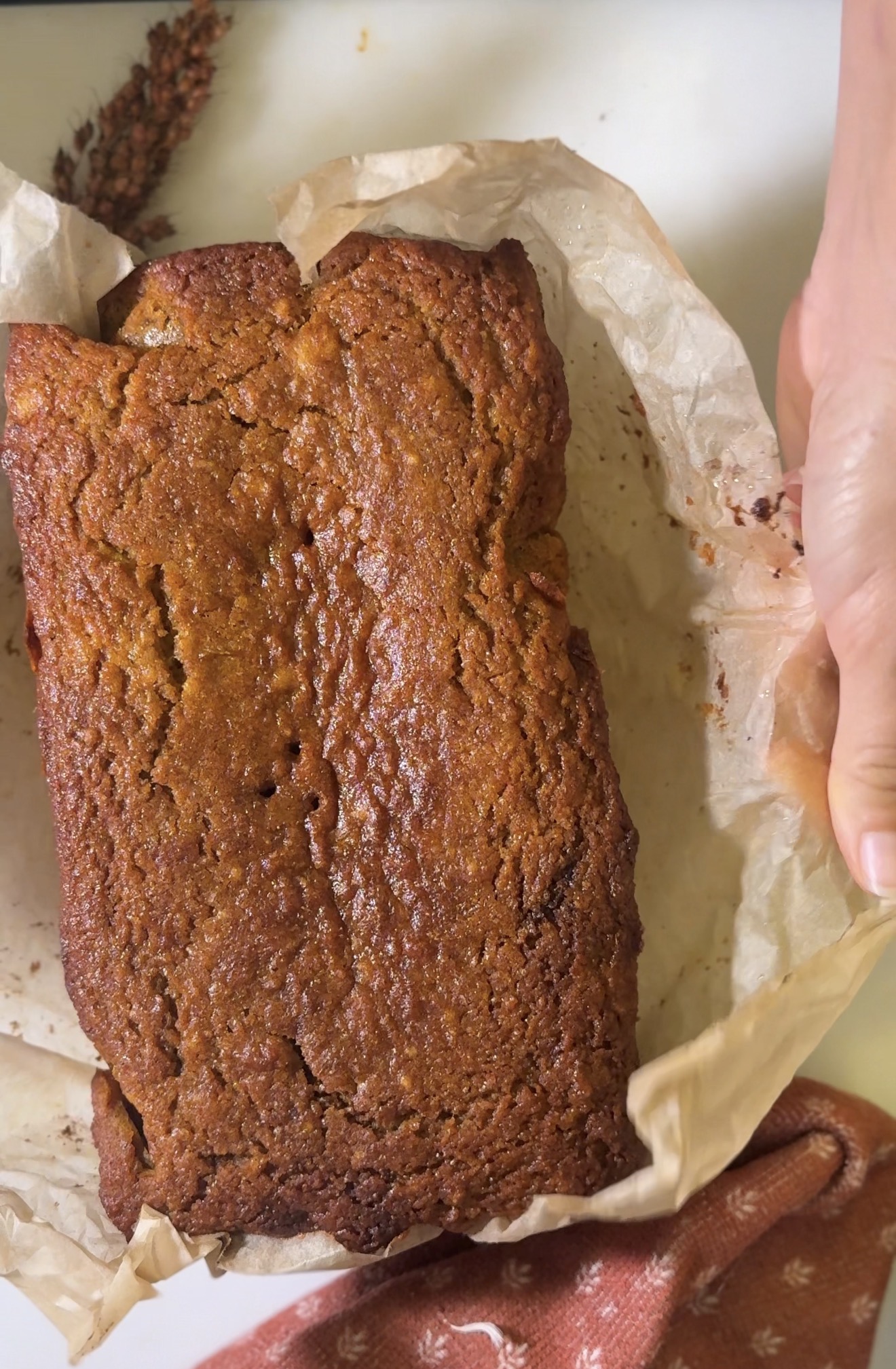
There is something about homemade pumpkin bread that makes the whole house feel cozy. The warm spices, the smell of pumpkin baking, and a thick slice with a little butter on top. It’s one of those simple things I look forward to every fall.
I’ve been experimenting more with freshly milled grains, and this sourdough Kamut pumpkin bread turned out so beautifully that I knew I needed to share it.
It’s soft, perfectly moist, full of warm pumpkin flavor, and made with freshly milled Kamut flour and sourdough starter.
The secret? Giving the freshly milled flour time to hydrate before baking.
It’s one extra step, but it makes such a difference in the finished texture.
Why I Love Baking With Kamut Flour
Kamut is an ancient variety of wheat, also known as khorasan wheat, with a naturally buttery, slightly sweet, nutty flavor.
It’s especially delicious in recipes like pumpkin bread because its flavor complements cinnamon, pumpkin, and other warm spices.
But beyond the flavor, I love the nutritional benefits of using whole-grain Kamut.
Kamut provides several important nutrients, including:
- Protein: Helps support muscle maintenance, growth, and repair.
- Magnesium: Plays an important role in muscle function, energy production, and hundreds of processes throughout the body.
- Zinc: Supports normal immune function and tissue repair.
- B vitamins: Help our bodies turn the food we eat into usable energy.
- Fiber: Supports digestive health and helps keep us satisfied.
- Antioxidant compounds: Kamut contains carotenoids and polyphenols, which contribute to its nutritional profile.
Kamut is still wheat and contains gluten, so it isn’t suitable for anyone with celiac disease.

Why I Freshly Mill My Flour
One of the reasons I’ve fallen in love with milling my own grain is that I get to use the entire wheat berry.
A wheat berry contains three important parts:
The bran: The fiber-rich outer layer that also contains minerals and beneficial plant compounds.
The germ: The nutrient-dense portion containing healthy fats, vitamin E, B vitamins, and other nutrients.
The endosperm: The starchy portion that provides carbohydrates and protein.
When flour is refined into conventional white flour, the bran and germ are removed.
By milling whole Kamut berries at home, I’m keeping all three parts of the grain in my flour.
That means I’m incorporating the fiber, naturally occurring oils, vitamins, and minerals that come with the whole grain.
Fresh milling also gives flour a wonderful aroma and flavor that I really enjoy.
While freshly milled flour isn’t automatically more nutritious than every commercially milled whole-grain flour, it’s a simple way to make sure I’m using the entire grain.
And I love knowing exactly what’s going into the food I’m making for my family.

Why Freshly Milled Flour Needs Time to Hydrate
If you’ve ever baked with freshly milled flour and ended up with something dry, dense, or crumbly, this might be the step you’re missing.
Freshly milled whole-grain flour behaves differently from refined white flour.
Because it contains the bran and germ, it takes time for the flour to fully absorb moisture.
When you immediately mix everything together and put it in the oven, some of those coarser particles haven’t had enough time to soften.
That’s why I give my freshly milled Kamut flour a 45–60 minute hydration period before finishing the batter.
During this rest:
- The bran absorbs moisture and begins to soften.
- The flour becomes more evenly hydrated.
- The gluten-forming proteins have time to absorb water.
- The mixture becomes smoother and more cohesive.
The result can be a softer, more tender crumb with fewer dry or gritty bits.
Kamut’s gluten behaves differently from modern bread wheat, so the goal isn’t to develop a strong, chewy bread dough. We want enough structure to support the loaf while keeping that beautiful, soft pumpkin-bread texture.
And because this recipe includes sourdough starter in the hydration mixture, a little fermentation begins during the resting period too.
What Does the Sourdough Starter Do?
I love finding ways to incorporate sourdough into everyday recipes, not just traditional sourdough bread.
In this recipe, the sourdough starter adds a subtle depth of flavor and contributes moisture to the batter.
You can use active starter or sourdough discard.
Unlike a traditional sourdough loaf, this pumpkin bread doesn’t rely on the starter for its rise. Baking powder and baking soda do most of that work.
And because we’re only resting the mixture for about an hour, this isn’t a long-fermented sourdough recipe.
If you’re specifically looking for the effects of extended fermentation, you’d need a different method. Try my long-fermented sourdough pumpkin bread recipe.
But for a simple, same-day pumpkin bread with the flavor of sourdough and the benefits of whole-grain flour, this recipe is wonderful.
Fresh-Milled Kamut Sourdough Pumpkin Bread Recipe


Fresh-Milled Kamut Sourdough Pumpkin Bread
Ingredients
Method
- Step 1: Hydrate the freshly milled flour In a large bowl, combine the freshly milled Kamut flour, sourdough starter, 100g pumpkin purée, and whole milk. Mix until all the flour is incorporated. Cover and let the mixture rest at room temperature for 45–60 minutes. This is the step that allows the whole-grain flour to absorb moisture before the remaining ingredients are added.
- Step 2: Mix the remaining wet ingredients In a separate bowl, whisk together the remaining 325g pumpkin purée, eggs, granulated sugar, brown sugar, melted butter, and vanilla. Mix until smooth.
- Step 3: Combine Add the wet ingredients to your hydrated flour mixture. Fold gently until everything is incorporated.
- Step 4: Add the dry ingredients In a small bowl, whisk together the baking powder, baking soda, salt, pumpkin pie spice, and cinnamon. Sprinkle over the batter and gently fold until evenly distributed. Avoid overmixing.
- Step 5: Bake Preheat the oven to 350°F. Pour the batter into a greased 9 × 5-inch loaf pan. Bake for approximately 55–70 minutes, or until a toothpick inserted into the center comes out without wet batter. If the top begins browning too quickly, loosely cover it with aluminum foil.
- Step 6: Cool and enjoy Let the pumpkin bread rest in the pan for 10–15 minutes before transferring it to a wire rack. Allow it to cool before slicing. Serve with butter and enjoy!
Tips for Baking With Freshly Milled Kamut
Don’t skip the hydration period. This is especially helpful when using freshly milled whole grains because the bran needs time to absorb moisture.
Use a kitchen scale. Weighing your flour is much more reliable than measuring by volume, especially when you’re milling your own grain.
Don’t overmix the batter. We want a tender pumpkin bread, not a chewy loaf.
Use plain pumpkin purée. Make sure you’re using pumpkin purée rather than sweetened pumpkin pie filling.
Check for doneness in the center. Pumpkin bread is naturally moist, so the edges can look finished before the center has baked through.
Frequently Asked Questions
Can I use sourdough discard?
Yes! Both active sourdough starter and discard work in this recipe. Because baking powder and baking soda provide the primary rise, your starter doesn’t need to be at peak activity.
Can I use store-bought Kamut flour?
Yes. Whole-grain Kamut flour should work, although the texture and hydration may vary depending on how finely it was milled.
Can I use another freshly milled grain?
You can experiment with other wheat varieties, but different grains absorb moisture and develop gluten differently. The results may not be identical.
Does soaking freshly milled flour make it easier to digest?
Hydrating the flour helps improve its baking properties, but a short 45–60 minute rest isn’t the same as an extended fermentation. It shouldn’t be assumed to significantly reduce phytic acid or make gluten safe for people who cannot tolerate it.
How should I store this pumpkin bread?
Keep it tightly wrapped or in an airtight container for up to two days at room temperature, or refrigerate for longer storage.
You can also slice and freeze it for up to three months.
A Simple Way to Bring More Whole Grains Into Your Kitchen
One thing I’ve learned about making more food from scratch is that it doesn’t have to be complicated.
Sometimes it’s as simple as swapping conventional flour for freshly milled grain and giving it a little extra time to hydrate.
This pumpkin bread is a perfect example.
It still tastes like the soft, sweet, cozy pumpkin bread we all love, but it’s made with whole-grain Kamut, sourdough starter, and ingredients I feel good about using in my kitchen.
And that is exactly the kind of baking I love sharing.
If you make this fresh-milled Kamut sourdough pumpkin bread, I’d love to hear how it turns out!
Leave a Reply